
Manual of product Civic Sedan (1998)
Editorial note
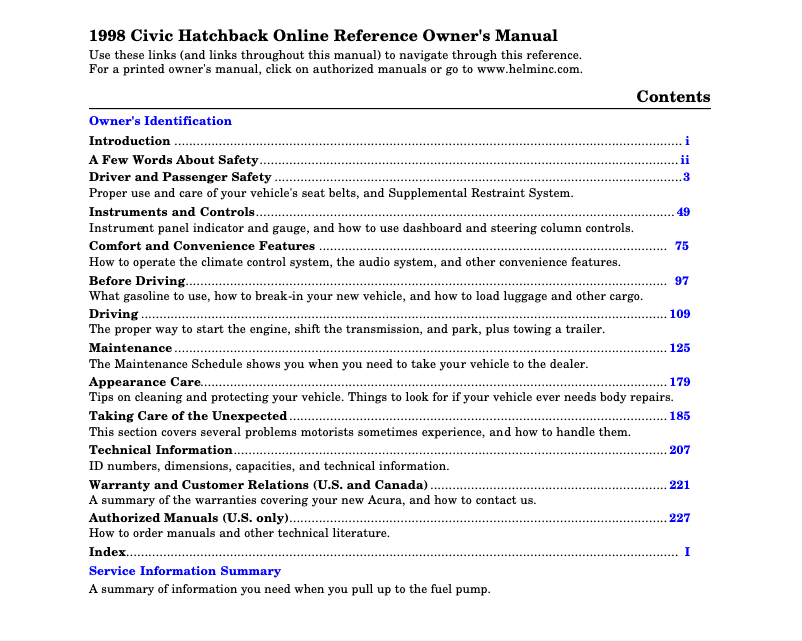
The 1998 Honda Civic Sedan is an iconic model that embodies reliability and durability, characteristics that have made the Honda brand renowned. With a remarkable robustness score of 90, this car offers peace of mind to owners, thanks to its proven longevity. Its fuel efficiency is also a major asset, ensuring reduced operating costs, although it is important to note that fuel consumption may be less competitive compared to newer models. In terms of comfort, the well-designed interior and comfortable seats contribute to an enjoyable driving experience, which is reflected in the user experience score of 75. However, some may find the interior design outdated, which could affect their overall satisfaction. Despite some limitations in modern features, such as the lack of advanced navigation systems, the value for money is high, with a score of 85. The availability of spare parts and ease of maintenance, rated at 70, make this car a practical choice for drivers. In summary, the 1998 Honda Civic Sedan remains a solid choice for those seeking a reliable and economical car, while keeping in mind that it may lack some modern amenities. The available user manual is a plus to facilitate the maintenance and use of the vehicle.Score details
User experience
The user experience is generally positive, thanks to a well-designed interior and comfortable seats, although the interior design may seem outdated to some.
Performance
The performance is adequate for daily use, but fuel consumption may be less efficient compared to newer models.
Design
The timeless style of the 1998 Honda Civic Sedan combines classic aesthetics with modernity, although some may find it dated.
Value for money
Its recognized reliability and fuel efficiency make it a good value for money, despite some limitations in modern features.
repairability
Maintenance is generally straightforward with widely available spare parts, although their availability may sometimes be limited.
Robustness
The durability and longevity of the Honda Civic are major assets, providing peace of mind to owners.
Usability
Ease of use is satisfactory, although the lack of certain modern features may detract from the overall experience.
Features
The 1998 model lacks some modern features such as advanced navigation systems, which may be a drawback for some users.
Documentation
The user manual is available, which can assist owners in the maintenance and use of the vehicle.
Advantages
Recognized reliability and durability
Optimal energy efficiency
Pleasant driving comfort
Simple maintenance and available parts
Timeless and attractive design
Disadvantages
Lack of modern features.
Less efficient in fuel consumption.
Outdated and uncomfortable interior design.
Limited availability of spare parts.
Obsolete safety standards.
Technical Specifications Civic Sedan (1998)
General Information
-
ModelCIVIC SEDAN (1998)
-
Brand
-
Category
-
Type
-
SKU794416
-
MPN794416
Frequently Asked Questions
How to convert miles to kilometers?
Where is the VIN number on my Honda?
What is the VIN number?
What is the recommended frequency for servicing my Honda?
How often should I change the brake fluid in my Honda?
What is the difference between E10 and E5 gasoline?
What should I do if one or more doors do not open from the inside?
My car radio won't turn on, what should I do?
Is the manual for the Honda Civic Sedan (1998) available in French?
Similar products


More product categories from brand Honda
Other Honda
Tools Honda
More product types from brand Honda







Presentation of product Civic Sedan (1998) specifications from brand Honda
General Information
The model Honda Civic Sedan (1998) comes from the renowned brand Honda, known for its reliability and innovation in the automotive industry. This vehicle is designed to offer optimal performance and a satisfying driving experience. The 1998 Honda Civic Sedan stands out with its timeless design that combines classic elegance and modernity.
Advantages
Among the notable strengths of the Honda Civic Sedan (1998), we find:
- Proven reliability: This model is famous for its durability, providing peace of mind to owners.
- Fuel efficiency: The 1998 Civic Sedan is designed to be fuel-efficient, helping to reduce travel costs.
- Driving comfort: Its well-arranged interior and comfortable seats ensure a pleasant experience on the road.
- Ease of maintenance: Replacement parts are readily available, making maintenance convenient for drivers.
- Timeless style: Its design remains appealing, combining classic aesthetics with modern touches.
Disadvantages
However, the Honda Civic Sedan (1998) also has some drawbacks:
- It may lack certain modern features, such as advanced navigation systems and driving aids, common in recent vehicles.
- Fuel consumption, while reasonable, may be less efficient compared to contemporary models, potentially leading to higher operating costs.
- The interior design and materials used may seem outdated, which can affect comfort for some users.
- The availability of replacement parts may sometimes be limited, complicating repairs and maintenance.
- In terms of safety, this model may not meet current standards, raising concerns for some drivers.


